Position Listings
Professional Positions
None listed at present.
Fixed-Term, Visiting, Postdoctoral & Technical Positions
Post-Doctoral Position (3 Year), Institute of Evolutionary Biology, University of Warsaw, Warsaw, Poland
Posting Date: 13 October 2026
Closing Date: 1 November 2026
We are hiring a 3-year postdoctoral researcher (at the level of Assistant Professor) at the Institute of Evolutionary Biology of the University of Warsaw, to join Dr Mateusz Tałanda's lab. The position is funded through an OPUS project (of the Polish National Science Centre) and focuses on the study of the evolution and biogeography of lacertoid lizards.
Squamate reptiles (lizards and snakes) are the most species-rich terrestrial vertebrates, surpassing even birds in this regard. Lacertoidea is one of the major groups of squamates, including amphisbaenians (worm lizards), the true lizards (lacertids) known from Poland, as well as teiids and gymnophthalmids. Their distribution is rather puzzling: the predominantly subterranean amphisbaenians occur on the greatest number of continents, even though they only originated in the Cretaceous period. Other groups — which might seem more mobile — are restricted to either the New or the Old World. Unfortunately, we know little about their early history. Undisputed representatives of these groups usually appear in the fossil record only in the Cenozoic, and their highly distinctive morphology makes it difficult to identify features that unite the major clades. This gap in our knowledge has broader implications, because molecular data place Lacertoidea alongside snakes, iguanians, and anguimorphs, yet we have no idea what anatomically links them. This, in turn, hinders discussions about the origins of snakes, iguanians, or mosasaurs, as we do not know what to expect from the ancestors of these groups.
The aim of this project is to determine the early evolution of Lacertoidea, their biogeographic history, and the traits of their ancestors. To achieve this, data will be collected on the phenotypic diversity of living representatives, Cenozoic and Mesozoic species, and especially the rich collection of Cretaceous lizards from the Gobi Desert in Mongolia housed at the Institute of Paleobiology of the Polish Academy of Sciences. Broader sampling of species and phenotypic traits will make it possible to build more reliable phylogenetic trees and to test the phylogenetic position of a wide range of fossils. This will then be used to identify ancestral characteristics, places of origin, and patterns of dispersal of these lizards. Reconstructing the early history of Lacertoidea is important because these animals are used as model species in ecomorphological and evolutionary developmental studies. These lizards help us understand processes responsible for limb reduction, test the principle of evolutionary irreversibility, and even examine the selectivity of mass extinctions. The planned research will provide the evolutionary context for the issues mentioned above.
If you are interested in applying to this position, please contact Dr Mateusz Tałanda via email: https://ibe.biol.uw.edu.pl/en/people/talanda/
Educational Opportunities
PhD Opportunity (Reducing Uncertainty in the Impact of Climate on Biodiversity), UNRISK Centre for Doctoral Training, University College London (Earth Science), London, UK
Posting Date: 13 October 2026
Closing Date: 13 January 2027
We are offering a PhD project via the UNRISK Centre for Doctoral Training (https://unrisk-cdt.ac.uk/) entitled 'Reducing uncertainty in the impact of climate on biodiversity’.
Marine ecosystems are under escalating pressure from climate change, yet our ability to forecast their future is limited by datasets spanning only decades. Models (e.g.species distribution models) built on such short records carry hidden uncertainties, which weaken the predictions that policy depends on.
This PhD will tackle the problem by mining “dark data” (historical survey reports, museum collections, and fossil archives) to build long-term datasets for two key marine groups: arthropods and corals. With these, the student will quantify how much uncertainty current ecological models are missing, and show how historical and deep-time baselines can reduce it.
Background
Species distribution models (SDMs) aim to constrain the response and distribution of organisms to climate change. However, these models are built on ecological monitoring records spanning decades rather than the hundreds of thousands of years and broader climatic landscapes that species have persisted in. This means any model based on these records is highly overfit and the predicted response is biased to the current climatic window. SDM predictions therefore have previously unrecognised and unaccounted for uncertainties.
Palaeontology and historical ecology can address this, using fossil records, museum collections and archival data to extend baselines far beyond living memory. Advances in digitisation and AI-driven data extraction are now unlocking vast amounts of previously inaccessible “dark data”, enabling richer, longer-term ecological datasets. These deeper records can feed into ecological models to capture and reduce uncertainty in SDM predictions.
PhD Project
Marine ecosystems face escalating pressure from climate change, yet our ability to forecast their future is fundamentally limited by short-term datasets. This introduces unaccounted-for uncertainties into ecological models and limits their usefulness for informing policy.
This PhD will tackle this challenge by applying data mining to ‘dark data’, generating long-term datasets for two important marine groups, arthropods and corals. This will quantify and address unaccounted-for uncertainties in present ecological modelling approaches.
AI-based methods (e.g. text and image mining) will be developed and applied to extract ecological data from diverse sources at scale. This will be used to build robust ecological baselines spanning the Quaternary (last 2.5 million years), giving a long-term view of how these groups have responded to past environmental changes. This record exists scattered across historical survey reports, museum collections, and fossil archives but it is largely inaccessible, undigitised, or unstructured.
Uncertainty will be quantified by comparing predictions for datasets with and without long-term records. Evaluation of differences in prediction interval, extrapolation error, and hindcast skill against known climate transitions will validate the method and provide a framework that can be applied to risk projections for marine biodiversity and the ecosystem services they underpin across a range of taxonomic groups.
These baselines will feed into the development of new species distribution models, incorporating both taxonomic and functional ecology data, to generate improved, more confident predictions of how arthropods and corals will respond to future climate scenarios.
This project will be co-supervised by Dr Lewis A. Jones at the Natural History Museum, London, an expert in corals and ecological modelling, and provide access to large collections of material including modern, historical and fossil.
Applicant Profile
This project would suit students with a strong quantitative and computational background in a field such as environmental/Earth science, ecology, biology, palaeontology, computer science, or a related discipline. The student should be comfortable working with data in R or Python and keen to develop these skills further in an interdisciplinary research setting.
Essential is a genuine interest in applying data science and machine learning approaches to ecological and palaeontological questions. Prior experience in data analysis, statistics, or coding is highly desirable, as much of the project involves developing AI-driven tools to extract and analyse large, complex datasets.
No prior experience with fossils is required, though an interest in using the fossil record and deep-time perspectives to understand present-day biodiversity change would be an advantage. Similarly, a background in ecology (marine or otherwise) is welcome but not essential. What matters most is enthusiasm for combining ecological thinking with modern computational methods to answer questions about how species and ecosystems respond to environmental change over long timescales.
Other Information
- Dr Stephen Pates’ personal website (Primary Supervisor): https://www.stephenpates.com
- Dr Lewis A. Jones’ personal website (Secondary Supervisor): https://www.lewisajones.com
- Invertebrate Palaeontology Research Group: https://www.ucl.ac.uk/mathematical-physical-sciences/earth-sciences/research-earth-sciences/research-groups-and-affiliated-institutes/palaeontology/invertebrate-palaeontology
PhD Opportunity Institut de Ciències del Mar (ICM-CSIC), Barcelona, Spain
Posting Date: 14 October 2026
Closing Date: 31 October 2026
Together with Elizabeth Sibert (WHOI), we are looking for a PhD candidate for the Spanish FPU scholarship programme to work with me at the Institut de Ciències del Mar (ICM-CSIC) in Barcelona, and through a secondment with Elizabeth at Woods Hole on the project "Early Miocene Atlantic–Mediterranean marine ecosystem change investigated through fossil fish remains and ecological modeling".
The Early Miocene (23–17 Ma) was a period of global marine biotic change. However, many of its aspects remain unknown and understudied. The objectives of this thesis will be to: a) reconstruct the Atlantic and Mediterranean fish communities; b) place the detected fish biodiversity and fish paleoecological changes within the dynamic Early Miocene paleoclimatic, paleoceanographic and paleogeographic context; and c) investigate potential impacts on marine ecosystem structure. The PhD student will be trained in paleontological, geochemical and ecological modelling methods. They will be incorporated in the iMARES research group of ICM-CSIC, and will collaborate closely with the Science Team of the IODP3 Expedition 505S ENIGMA.
The successful candidate will join the iMARES research group, a dynamic team of senior scientists, postdoctoral researchers, and PhD students based at the ICM-CSIC, a leading marine research centre awarded the prestigious Severo Ochoa Centre of Excellence distinction. The group provides an excellent training environment through participation in specialized courses, conferences, research stays, seminars, and collaborative activities, while fostering an inclusive and supportive research culture.
Please note that the FPU programme is very competitive, so only students that have graduated in the last few years AND with a BSc grade greater than 8.5/10 are eligible.
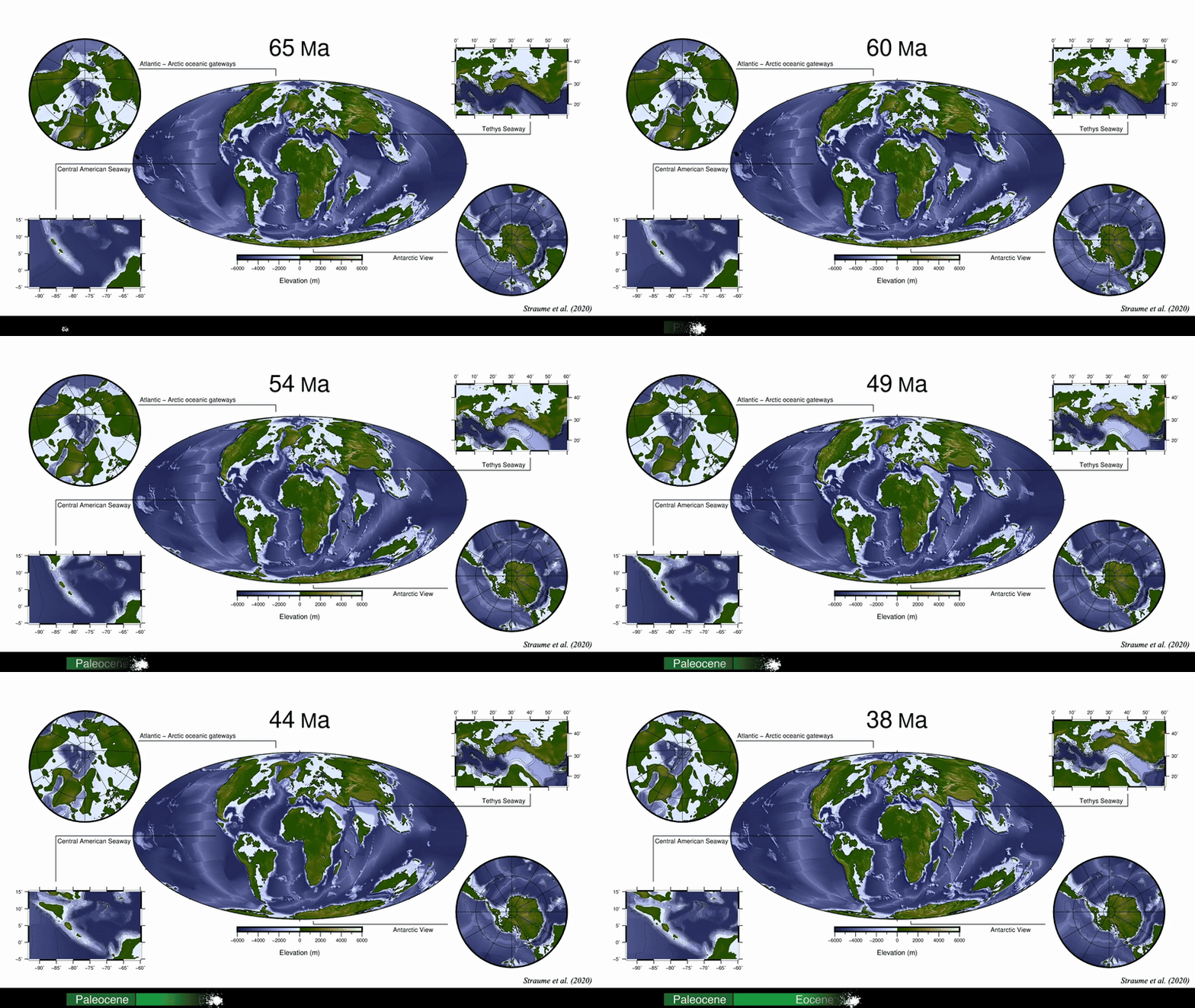
PhD Opportunity (How did the Closure of the Tethys Ocean Impact Global Marine Biodiversity?), Training, Research & Equity in Environmental Sciences Program, UK
Posting Date: 14 October 2026
Closing Date: None Given
The closure of the Tethys Ocean during the Miocene represents one of the most profound reorganisations of Earth’s surface systems in the Cenozoic. Once a vast marine corridor linking the Indo-Pacific with the Atlantic and Mediterranean, the progressive narrowing and final disappearance of the Tethys dramatically altered ocean circulation, climate, and the dispersal opportunities available to marine organisms. While the geological processes of closure are increasingly well understood, its ecological and biogeographic consequences for global biodiversity remain less clearly resolved.
This PhD project will investigate how the restriction and closure of the Tethys Seaway shaped global marine biodiversity patterns, with a particular focus on dispersal and diversification dynamics. The research will ask: (1) How did changing gateway geometries influence dispersal pathways and connectivity among marine provinces? (2) Did diversification events coincided with key phases of seaway restriction? (3) Did biodiversity hotspots shift in response to declining connectivity? (4) How did coral assemblages reorganise ecologically in response to declining dispersal opportunities and habitat fragmentation?
Synthesis of fossil occurrence records will track how marine biodiversity changed through space and time in response to the closure of the Tethys Ocean. Dispersal modelling using palaeogeographic reconstructions and ocean circulation simulations will quantify potential connectivity between regions. Macroevolutionary analyses will test for links between seaway restriction and diversification pulses. Ecological comparisons across the Indo-Pacific, Mediterranean, Paratethys, and Atlantic will reveal how communities reorganised under declining connectivity. This research will provide new insights into how large-scale earth system changes reshape marine biodiversity.
Project-Specific Training
The student will receive tailored training in fossil data synthesis, dispersal modelling, macroevolutionary analysis, and ecological community comparison, delivered through one-to-one supervision and collaboration with external partners. They will develop computational skills in handling large-scale datasets, geospatial analysis, and coding (R, Python), alongside experience with palaeogeographic reconstructions and ocean circulation simulations. There is also scope for the student to gain palaeontological fieldwork experience if desired. Professional development in scientific writing, presentation, and open research practices will also be gained to prepare the student for technical roles within or outside of academia.
Potential Career Trajectory
This project will equip the student with a unique combination of expertise in palaeobiology, ecological modelling, and computational analysis, supporting career pathways in both academia and beyond. Within academia, the training provides a strong foundation for postdoctoral research and faculty positions in palaeontology, evolutionary biology, biogeography, or earth system science. Beyond academia, the quantitative, data-intensive, and interdisciplinary skills developed are highly transferable to roles in environmental consultancy, biodiversity conservation, natural history museums, geoscience and climate modelling, and science communication or policy, where the ability to integrate complex datasets to address global change questions is increasingly valued.
Project Supervisors
Lewis Jones, Earth Sciences, The Natural History Museum
Lewis.Jones@ucl.ac.uk
https://profiles.ucl.ac.uk/101867-lewis-jones
Bridget Wade, Earth Sciences, University College London
b.wade@ucl.ac.uk
https://www.ucl.ac.uk/mathematical-physical-sciences/earth-sciences/people/prof…
Nadia Santodomingo, Marine Zoology, Senckenberg Research Institute and Natural History Museum Frankfurt/M.
nadia.santodomingo@senckenberg.de
Francesca Bosellini
Dipartimento di Scienze Chimiche e Geologiche, University of Modena and Reggio Emilia
francesca.bosellini@unimore.it
Sponsors