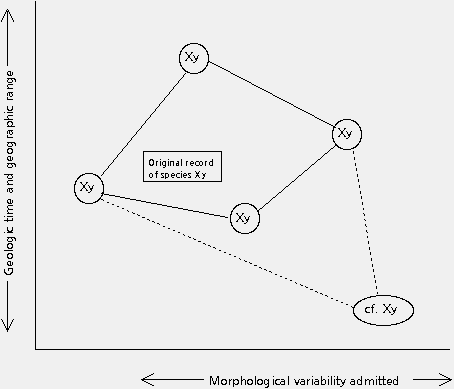
A fundamental problem in the recording of paleontological data is that the concept of a particular species changes from year to year and decade to decade, as more and more occurrences of identical or slightly different populations are found and recorded, over an expanding geographic area and increasing stratigraphic range. In the following diagram, occurrences in circles are recorded subsequent to the original record, and increase the morphological variability admitted into the concept of the species.
The occurrence recorded as "cf. Xy" has the effect of casting doubt on both the extent of morphological variability and the stratigraphic and geographic range of the species.
In a series of papers culminating in a highly significant little book, Hughes (1989) developed a radical solution to this problem, centered on a new type of taxonomic unit, the "paleotaxon". A paleotaxon, and its variability, is recorded from a single sample and cannot ever be emended or changed. The essential part of its name is the name of its originator plus date (and hour if more than one paleotaxon is established in a day), to which can be added three short terms indicating fossil group, age, and a descriptor. Any necessary later comment becomes a new paleotaxon (with new author/date) which is complete in itself and which incorporates a full reference to the old record.
Subsequent finds of a paleotaxon are recorded, not simply as additional occurrences of the entity, but as one of three types of "graded comparison records", as follows -
It is not possible to give here more than the merest flavor of Hughes' proposed Paleontologic Data-Handling Code which, in addition to dramatically reducing the uncertainty in records of occurrences of fossils, contains suggestions also for a system of classification and for stratigraphic correlation procedures.